Showing posts with label David Austin. Show all posts

Sunday, 21 October 2012

459: Gay Politics: Dressing to the Left

Obviously the big gay political movement of the 1970s was the fight for civil rights aka Gay Lib which began at the end of 1969. Independent of the activists involved in Gay Lib, homosexuality began to appear as an issue of concern to nice liberal heterosexual folks. But as part of a political programme, homosexuality was most readily incorporated within the broad array of issues proclaimed by the post-hippie Radical Left (aka New left in America). Homosexuality was a part of political platforms which included diversity, feminism, gender equality, minority-rights and strident non-racism. Heady radical stuff, you’ll agree. Or wholly unrealistic, preposterous, pie-in-the-sky demands proposed by anti-social types who felt that government should be lavishing the public purse on irrelevant grievances if you’re of a more conservative disposition. So: a concern for homosexuality was a shortcut to portraying leftist politics as ludicrous by association.


By David Langdon
Punch, 24 September 1975

These would be protestors outside the annual Conservative Party Conference. The newspaper vendors are the opposite of moderate, but the person holding “Gay News” doesn’t appear to gay as such.


from Auberon Waugh’s Diary
“Private Eye”, 9 December 1977

There’s a certain amount of accompanying style from Waugh here, but it’s really just the well-worn conceit that a gay worker would only be a hairdresser. A brief knock at literary/political freeloaders, leftists, and homosexuals in the Waugh manner.


by David Austin
Spectator, 27 June, 1981

The Left’s obsessive concern with gender roles and issues over practical matters.


Illustration by John Johnsen
“Punch”, 17 March 1982

To accompany an article “”Spring Diary of a Social Worker”, who by the turn of the decade were seen as the local government-employed shock troops of leftist socio-political engineering. Even the socialist alternative comedian Alexei Sayle had his joke: “Help a deprived inner city child. Kill a social worker”. The homsoexuals holding the banner appear to be a curious mix of New romnatic, Gay 90s dandies, and Radcliffe Hall butch tweedy lesbians

Out of gay political groups came numerous short-lived magazines and publishing endeavours. The public might be aware of the existence of this sort of minority-interest stuff, but no specific title or approach is going to make a massive impression on general consciousness. So you can’t specifically parody a particular author or title. They fall too far below the radar. However, it is the gay-positive content in other leftist magazines that will make the general populace aware of gay issues and give a forum for gay voices, lifestyles and activities. There are lots of feminist and leftist journals, but as they solely political magazines they have a limited audience. The most famous example of such a magazine in the UK is “Time Out”. “Time Out” was a listing magazine, detailing the weekly events in London, and so its functionality meant that its readers encountered the leftist political life of London. Hence these two parodies of “Time Out” make much out of the gay oriented content of the magazine.


“Private Eye”, 5 June 1981


“Private Eye”, 28 August 1981

Readers with incredibly retentive memories will note that that in these two parodies there’s a lot of cross-over with the parodies attacking the irrelevant, wastefulness, social rebalancing by Ken Livingstone and the 1980s GLC (Greater London Council). I already covered a lot of those satirical attacks that used GLC’s support of homosexuality against it (20 different bits starting here). But here are a couple more from Michael Heath’s “The Gays” strip:


“Private Eye”, 23 October 1981


“Private Eye”, 26 February 1982


“Private Eye”, 11 March 1983


“Private Eye”, 6 May 1983

And let’s just round out with a silly sexual / political pun.


Spectator, 4 September 1982

Thursday, 31 May 2012

413: Michael Trestrail

Something for the Jubilee. Something other than just posting a load of puns involving the word “Queen”, mind you. So something related to her majesty specifically instead – which will mean a few “queen” jokes, I’m afraid, but what can I do about that. I have no time machine to forcibly restrain people from making these slightly lame jokes in the first place.

One of the odder incidents before her children and their marriages became a thriving tabloid feature (toe-sucking, squidgygate, I want to be your tampon, etc.) was the incident in July 1982 when the Queen was visited by an intruder in her bedroom. Michael Fagan climbed over the walls surrounding Buckingham palace, broke into Buckingham Palace undetected, then made his way to the Queen’s bed chamber, where he woke her up and sat on her bed for about 10 minutes.

This was the sixth breach of security at the Queen's London residence that year and there was a clamour to know why the Queen’s security had been breached so many times. On July 19th the Home Secretary Willie Whitelaw announced to a stunned parliament that the Queen’s chief of security, Commander Michael Trestrail had resigned, not because of any failings in his job but because he had been involved in a relationship with a male prostitute.

The 51 year old Trestrail had worked for the Royal Family since 1966, and had become a Member of the Royal Victorian Order in 1978, a personal award of the Queen. It was revealed that several years previously Trestrail had met a couple of times with Michael Rauch, a male prostitute in his 30s. When Rauch had discovered Trestrail’s position he had tried to blackmail him but nothing had come of it. Following the interest in Fagan’s break-in, Rauch tried to sell his story to “The Sun” newspaper, but the tabloid instead passed this information to Scotland Yard.

Trestrail immediately resigned. All of this was not just embarrassing to the palace but also to the government. Trestrail was security checked every couple of years, and his last vetting had only been 3 months previously. Furthermore, Trestrail’s resignation occurred independently of any awareness by the government. Whitelaw was only in the position of announcing what had already happened. Various investigations would follow, which would open up the more private operations of the palace making it more accountable.

Most of the papers and commentators were largely sympathetic to Trestrail. The Attorney General announced: “There should be no general presumption that homosexuality is evidence of inherent personality defects disqualifying the individual from positions of responsibility”. There was an investigation by Lord Bridge, with the report issued in November 1982. Trestrail was exonerated as “no threat to security at the palace”, nor responsible for the Fagan incident, although Bridge remarked on “casual and promiscuous homosexual encounters which (Trestrail) himself recognised as sordid and degrading …[which] still attracts general disapproval”. So if nothing else, an indication of how attitudes have changed in the last 30 years.

All the reports suggest an immensely private man, whose testimony gives the impression of being not entirely comfortable in his sexuality. Headlines and observations were full of the phrase “Secret Double Life”. Developing from the Vassall and Lavender scandals of the early 1960s most of the commentary is still about blackmailing of homosexuals, but now instead of campaigns for purges, the assumption is that honesty really is the best policy.

One good thing in all of the material that follows, almost none of it is directly or personally about Trestrail but only about the mix of homosexuality, royality, policeman, national security, and Fagan’s break-in.

Raymond Jackson
Evening Standard, 21 July 1982
As with almost very other JAK cartoon, if he’s not some effeminate sissy, then a homosexual is a large chap with extravagant facial hair in lady’s evening wear. Pythonesque or just lazy all-poofs-are-transvestite gags? Anyway, here they are infiltrating away like mad.

Michael Heath
Spectator, 24 July 1982
And here’s the first of our queen/ royalty meet’s queen / homosexual puns. Writes itself, wouldn’t you say?

Trog – aka Wally Fawkes
Observer, 25 July 1982
The police officer is Home Secretary Willie Whitelaw. But isn’t that just the mimsiest-looking chap on the step?

Michael Heath
Punch, 28 July 1982
A gay interpretation of the everyday behaviour of policemen. Could almost be a pocket cartoon by Marc Boxer, but none of Boxer’s pieces for “The Times” touch on this story's homosexuality even by allusion.

Punch, 28 July 1982
A Queen gag again. Anthony Blunt for previous secretly gay Royal employee allusion. Quentin Crisp as a default reference for homosexuality. And an ethos of secrecy about being gay.

cover, Private Eye 30 July 1982
A “Hello Sailor” joke. Ho-hum.

David Austin
“Hom Sap” strip in Private Eye, 30 July 1982
Austin is better than a joke whose pay-off is a hand on hip, and a “Haven’t we all, sweeties”? but this is for “Private Eye” in the early 1980s which wasn’t in the market for any subtlety in its jokes about homosexuals.

Michael Heath
“The Gays” strip in Private Eye, 30 July 1982
“It’s wonderful to feel persecuted again”?

David Austin
Spectator, 31 July 1982
An inversion of the whole Trestrail situation. Note the topical homosexual moustaches and realistic early 80s attire in contrast to the character in Trog’s cartoon.

Punch, 4 August 1982.
Listing all the gay signifiers in this would be almost as the piece itself: Cambridge and Foreign Office spies, hairdressers and ballet dancers, Oscar Wilde, leather gear and cottaging. No Jeremy Thorpe reference is surprising, although for those with a particularly good memory, a copy of Baldwin’s novel was involved in Thorpe’s seduction technique. The only other thing missing is some sort of disco reference, but then the audience of “Punch” isn’t hip in anyway.

Cartoon by Geoffrey Dickinson
E.J. Turner
Punch, 4 August 1982
A lengthy piece about the evident failures of the vetting procedure invoking the idea of “effeminate drinks”, James Bond’s odd piece of folklore about homosexuals not being able to whistle, Oxbridge traitors, bachelor holidays to gay venues, interior decorating, handbags, and so on. And a “gay men have handbags” reference in the cartoon too.

Michael Heath
“The Gays” strip in Private Eye, 13 August 1982
Not a bad gag in this context. Although still within general milieu of pity, misery, envy, petty lust, resentment and recrimination of the strip.

Private Eye, 13 August 1982
Easy “hello sailor” cliché aside, this instance looks at the sexual scandal element of the story, in regard to Trestrail’s consorting with prostitutes. The three signatories are all disgraced figures, but the Kincora Boys Homes is a low blow as that was a notorious contemporary paedophile scandal.

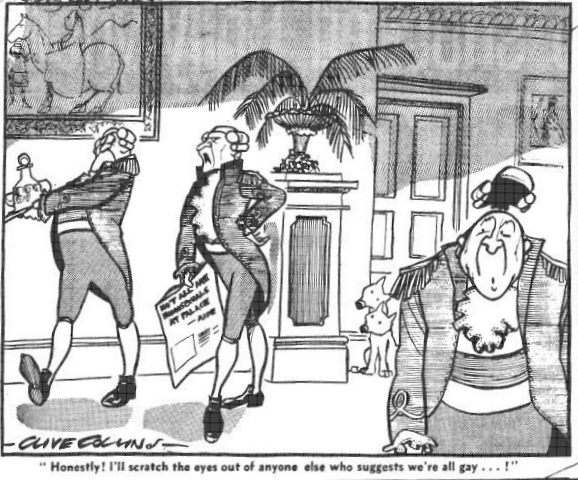
Clive Collins
The Sun, 31 August 1982
A camp bitchy gay. Again the idea of being pervasively infiltrated. Although the “I’ll scratch their eyes out” line has probably been a cliché for at least the last 10 years.

Private Eye
3 December 1982
Analysing the Bridge investigation as a cover-up so as not to further embarrass the Palace. Mr Sweeties Roughtrouser is a name revisited from jokes about Thorpe.

After that Trestrail falls out of the public eye. But there is one last reference. The second volume of Sue Townsend’s Adrian Mole books, “The Growing Pains of Adrian Mole” (1984) has the following topical entry, in which the events of the outside world are brought within Adrian’s self-obsessed petty orbit:

“MONDAY JULY 19TH “The Queen’s personal detective, Commander Trestrail, has had to resign because the papers have found out that he is a homosexual. I think this is dead unfair. It’s not against the law and I bet the Queen doesn’t mind. Barry Kent calls ME a poofter because I like reading and hate sport. So I understand what it is like to be victimized.”

Monday, 26 October 2009

304: Cocksuckers & Bloodsuckers - Gay Vampires 4

This summary is not available. Please click here to view the post.

Sunday, 26 April 2009

254: Classical Attitudes 1

What can we learn from a good grounding in classical history, literature and culture? That all those old Greek philosophers never read Leviticus.

by David Austin in “Private Eye” 10 August 1973. “Hom Sap” used a classical setting to make satirical points and jokes about contemporary political and social situations while also making jokes about the classical milieu.


by Phil Interlandi(signature unclear?) in “Playboy” August 1973. Refers to Diogenes who went about with a lantern in the broad daylight in a search for an honest man,

quotes from Love and Death (1975)
written and performed by Woody Allen

"I wonder if Socrates and Plato took a house on Crete during the summer."

“What would Socrates say? All those Greeks were homosexuals. Boy, they must have had some wild parties. I bet they all took a house together in Crete for the summer. A: Socrates is a man. B: All men are mortal. C: All men are Socrates. Means all men are homosexuals. Heh... I'm not a homosexual. Once, some cossacks whistled at me. I, I have the kind of body that excites both persuasions. You know, some men are heterosexual and some men are bisexual and some men don't think about sex at all, you know... they become lawyers.”

Monday, 9 February 2009

226: Adam and Steve

If at some time you haven’t had some supposed wit inflict: “If God had meant for there to be homosexuals, then he’d have made Adam and Steve, not Adam and Eve” on you then you’ve been jolly lucky. To which wisecrack the only reasonable response is jamming your thumb into their eye, and then while you’re got their attention explaining the theory of evolution, punctuating the more important principles by slamming their head against the wall.
Aaanyyyyy-hoooo. Cartoons in which some typically male/female couple is changed to became an all-male gay pair.


“Larry” in “Private Eye” 5 November 1971.
Darby and Joan is an English phrase used to describe a couple who’ve been married for many, many years. Social clubs for pensioners were called “Darby and Joan Clubs”. "Darby and John" would have seemed like a workable pun.
There’s a handbag, and I think the chap seated in the window on the far right is wearing pearls.

David Austin in “The Spectator” 20 August 1983
A gay Punch and Judy for a gay audience

Michael Heath in “The Spectator” 7 July 1982

Michael Heath in “Punch” 17 March 1982
More of a crappy pun, to be honest, and less impressive than a cartoon I’ve seen from the ‘70s of a performance of “Oklahomosexual”

Wednesday, 4 February 2009

220: Attack of the Clones / Send in the Clones / Stop Cloning Around

By the mid ’80-s even the most clueless of cartoonists had started to realise that most homosexuals were not quite the effeminate lipstick-wearing, flouncy sissies they had imagined. Gay cartoonists in gay magazines like “Christopher Street” and “Gay News” had been making jokes before 1980, but those were jokes for the gay audience familiar with the scene. Michael Heath’s “The Gays” strip had noticed fairly early on that there was a distinct new gay identity. Trend-spotter Peter York had an essay about this change in his in 1980 collection of journalism “Style Wars”. The prevalence and flagrancy of the clone, given a few additional touches by way of the leather cop from “The Village People”, would become an easy stereotype for cartoonists for almost the next two decades. Soon it was easy for even the laziest of cartoonists to suggest a homosexual through some combination of: a moustache, an earring, maybe a shaved head or a leather cap, a revealing shirt or string vest, and a bomber jacket. It allows the cartoonist to note that homosexuality is actually about sexuality, but the various elements can be figured to make it all seem a rather silly display (whether you feel that it’s a bit silly already is a whole other matter).

So, just a few, pretty much picked at random:

David Austin in “The Spectator”, 18 February 1984
Another “gay dog”, but now it’s the moustache that confirms homosexuality

“The Gays” by Michael Heath in “Private Eye” 27 July 1984
Is a gay man any more than the sum of his fetishes?

David Austin in “The Spectator”, 8 December 1984
A variant on the “we’re all individuals” line undercut by self-inflicted conformity.

David Austin in “The Spectator” 24 August 1985

Tom Johnston in “The Sun”, 7 March 1987
Pretty much all in one package. The tattoo “Harvey” is there to remind readers of Harvey Proctor, the Tory MP revealed to have had sex with a rent boy earlier in 1987. Kinnock and his two drinking companions are all Labour politicians. But a gay MP is a gay MP.
What would a scary homosexual be? Well just as silly, only larger.

“Are you trying to be funny? Yes we do take heterosexuals actually!”
Charles Griffin in “Daily Express” 6 April 1998
All the traditional effeminate stereotypes about what a gay army would mean. In the parody recruiting poster, all the clone clobber cannot hide inherent nelliness, as the pointing finger becomes a limp wrist. Which never happens in real life, no.

Bill McArthur in “The Glasgow Herald” 9 November 1998

Tom Johnston in “The Sun” 10 November 1998
Cliches about cruising gay men on Clapham Common, inspired by the “lapse of judgement” of Labour MP Ron Davies.

“Matt” in “The Daily Telegraph” 1998
If nothing else, this demonstrates what minimal effort is required to depict a gay cliché.

Dave Gaskill in “The Sun” 24 April 2000
Just your typical gay dad in a scene of congenial domesticity.

Tuesday, 9 December 2008

198: Jeremy Thorpe 16

by David Austin
from “Private Eye”, 15 September 1978

There was much foot-dragging by the prosecution service, but finally on 3rd August 1978, Jeremy Thorpe, Holmes, David Holmes, and George Deakin were formally charged with conspiracy to murder Norman Scott.
A little later in September there were suggestions of homosexual shenanigans at the National Liberal Club. The National Liberal Club had originally been founded by the Liberal Party but had been sold on a couple of years ealrier. So this was nothing to do with Thorpe, but David Austin conflates it all into one big Liberals = homosexual satirical shorthand. Whether “Sodom and Gomorrah” is anymore original than the contemporary tittering about Liberal “seats” is another matter.

Sunday, 15 June 2008

136: Cottaging - David Austin

And here are a few cartoons dancing around the idea of cottaging by David Austin (March 29 1935 - November 19 2005)

in "The Spectator" 30 October 1982

Note the jeans, cropped haircuts and moustache. Unlike Heath, whose “The Gays” strip was running at this time, Austin has got the casual clone-about-town look of this time down. “W.C”. is water-closet, another name for toilet, if you don’t already know. And we’ve seen a similar take on the same joke in Not the Nine O’Clock News’s “Gay Christian Sketch” – since of all the possible malapropisms or verbal stumbles, “come out of the toilet” is too close to an allusion on cottaging to be accidental.
The tension in the joke lies in the use of the phrase "coming out of the closet", the strong allusion to sx sex in toilets, and the overall mood of the piece as harmless wistful nostalgia.


in "Private Eye" 18 June 1982

There did indeed used to be a height requirement for policemen in the UK. My father's friend was a bit too short and it's aggravated him for the last forty years.

What cottaging also does in the public mind is take homosexuality from a realm of having been theoretically criminal, as it was in the past – just to be homosexual was illegal - and now gives it a description as a criminal activity which can monitored and judged. Pre-1968 it was all a little too metaphysical as crimes go, and polite society wasn’t paying attention to what was going on in toilets. The cartoons we saw by Larry from the 60s about police chasing down gay lovers were rather ridiculous. Now that the condition of homosexuality is legal, it is those specific activities taking place in toilets constituting “gross offences” which can be policed. Complementing its illegality, as far as public distaste goes, sex and toilets only heighten the unpleasantness of each other.
And so starting from here we have gay men and policeman tied together for comic effect for the next decade or so.

Monday, 12 May 2008

119: David Austin - Gay unicorns

David Austin in "The Spectator" 19 June 1982

Curiously, of all the hundreds and hundreds of gags, spoofs, jokes, comics, cartoons, sketches, songs, sitcoms, parodies and Christ alone only knows what I’ve let pass before my barely functioning eyes, I think this marks a watershed in humour using homosexuals.
It isn’t sneering or belittling. It isn’t proposing some particular stereotype or trying to keep up with new trends. It doesn’t allude to some new scandal or public contretemps. It isn’t arguing some satirical point, or even attacking modern bigotries from a liberalising viewpoint.
It is just a silly joke.
Homosexuality is allowed to play in the realm of nonsensical fantasy. It is not sectioned and limited for adult, topical, political or moralistic reasons.
As we have already seen there was a massive backlash on various fronts against homosexuality, but this is a backlash stemming from a sudden discomfort arising from the fact that the matter of homosexuality is acknowledged and homosexuals themselves more prevalent. And in its own innocuous way this cartoon proves it.
And this in the early 80s in a magazine like “The Spectator”. The “New Yorker” would run an almost identical cartoon a mere 25 years later. And that the “New Yorker” in America only really started to feature gay cartoons in the absolute end of the 80s and gradually through the 90s only proves my point.

(If one really really wants, one might just possibly catch the slightest sniff of early 80s gay-feminist politics and strident articles in “Spare Rib” about lesbians raising children and challenging the traditional heterosexual family unit. Please try not to, I ask you. Let’s not spoil this moment.)