Showing posts with label The Sun. Show all posts

Tuesday, 4 December 2012

467: AIDS 3: Avoid Like the Plague

All the casual disgust and revulsion occasioned in certain people by the mere existence of homosexuality, let alone any sexual practices, were given a full arena for open expression in the public health consequences of the apparent death sentence of AIDS. Homosexuals - not just innately detestably, and morally sick, but actual plague-carriers. So, thanks to the tabloid press, here’s the funny side of the leper’s bell:

----------------------
Stanley Franklin in The Sun, 26 February 1985


Bill Caldwell in The Daily Star, 19 February 1985
Stanley Franklin in The Sun, 5 December 1986

Stanley Franklin in The Sun, 10 July 1987

Two months before “The Sun”’s “Pulpit Poofs must stay” headline.


from the "The Appallingly Disprespectful Spitting Image Book", 1985

Thursday, 31 May 2012

413: Michael Trestrail

Something for the Jubilee. Something other than just posting a load of puns involving the word “Queen”, mind you. So something related to her majesty specifically instead – which will mean a few “queen” jokes, I’m afraid, but what can I do about that. I have no time machine to forcibly restrain people from making these slightly lame jokes in the first place.

One of the odder incidents before her children and their marriages became a thriving tabloid feature (toe-sucking, squidgygate, I want to be your tampon, etc.) was the incident in July 1982 when the Queen was visited by an intruder in her bedroom. Michael Fagan climbed over the walls surrounding Buckingham palace, broke into Buckingham Palace undetected, then made his way to the Queen’s bed chamber, where he woke her up and sat on her bed for about 10 minutes.

This was the sixth breach of security at the Queen's London residence that year and there was a clamour to know why the Queen’s security had been breached so many times. On July 19th the Home Secretary Willie Whitelaw announced to a stunned parliament that the Queen’s chief of security, Commander Michael Trestrail had resigned, not because of any failings in his job but because he had been involved in a relationship with a male prostitute.

The 51 year old Trestrail had worked for the Royal Family since 1966, and had become a Member of the Royal Victorian Order in 1978, a personal award of the Queen. It was revealed that several years previously Trestrail had met a couple of times with Michael Rauch, a male prostitute in his 30s. When Rauch had discovered Trestrail’s position he had tried to blackmail him but nothing had come of it. Following the interest in Fagan’s break-in, Rauch tried to sell his story to “The Sun” newspaper, but the tabloid instead passed this information to Scotland Yard.

Trestrail immediately resigned. All of this was not just embarrassing to the palace but also to the government. Trestrail was security checked every couple of years, and his last vetting had only been 3 months previously. Furthermore, Trestrail’s resignation occurred independently of any awareness by the government. Whitelaw was only in the position of announcing what had already happened. Various investigations would follow, which would open up the more private operations of the palace making it more accountable.

Most of the papers and commentators were largely sympathetic to Trestrail. The Attorney General announced: “There should be no general presumption that homosexuality is evidence of inherent personality defects disqualifying the individual from positions of responsibility”. There was an investigation by Lord Bridge, with the report issued in November 1982. Trestrail was exonerated as “no threat to security at the palace”, nor responsible for the Fagan incident, although Bridge remarked on “casual and promiscuous homosexual encounters which (Trestrail) himself recognised as sordid and degrading …[which] still attracts general disapproval”. So if nothing else, an indication of how attitudes have changed in the last 30 years.

All the reports suggest an immensely private man, whose testimony gives the impression of being not entirely comfortable in his sexuality. Headlines and observations were full of the phrase “Secret Double Life”. Developing from the Vassall and Lavender scandals of the early 1960s most of the commentary is still about blackmailing of homosexuals, but now instead of campaigns for purges, the assumption is that honesty really is the best policy.

One good thing in all of the material that follows, almost none of it is directly or personally about Trestrail but only about the mix of homosexuality, royality, policeman, national security, and Fagan’s break-in.

Raymond Jackson
Evening Standard, 21 July 1982
As with almost very other JAK cartoon, if he’s not some effeminate sissy, then a homosexual is a large chap with extravagant facial hair in lady’s evening wear. Pythonesque or just lazy all-poofs-are-transvestite gags? Anyway, here they are infiltrating away like mad.

Michael Heath
Spectator, 24 July 1982
And here’s the first of our queen/ royalty meet’s queen / homosexual puns. Writes itself, wouldn’t you say?

Trog – aka Wally Fawkes
Observer, 25 July 1982
The police officer is Home Secretary Willie Whitelaw. But isn’t that just the mimsiest-looking chap on the step?

Michael Heath
Punch, 28 July 1982
A gay interpretation of the everyday behaviour of policemen. Could almost be a pocket cartoon by Marc Boxer, but none of Boxer’s pieces for “The Times” touch on this story's homosexuality even by allusion.

Punch, 28 July 1982
A Queen gag again. Anthony Blunt for previous secretly gay Royal employee allusion. Quentin Crisp as a default reference for homosexuality. And an ethos of secrecy about being gay.

cover, Private Eye 30 July 1982
A “Hello Sailor” joke. Ho-hum.

David Austin
“Hom Sap” strip in Private Eye, 30 July 1982
Austin is better than a joke whose pay-off is a hand on hip, and a “Haven’t we all, sweeties”? but this is for “Private Eye” in the early 1980s which wasn’t in the market for any subtlety in its jokes about homosexuals.

Michael Heath
“The Gays” strip in Private Eye, 30 July 1982
“It’s wonderful to feel persecuted again”?

David Austin
Spectator, 31 July 1982
An inversion of the whole Trestrail situation. Note the topical homosexual moustaches and realistic early 80s attire in contrast to the character in Trog’s cartoon.

Punch, 4 August 1982.
Listing all the gay signifiers in this would be almost as the piece itself: Cambridge and Foreign Office spies, hairdressers and ballet dancers, Oscar Wilde, leather gear and cottaging. No Jeremy Thorpe reference is surprising, although for those with a particularly good memory, a copy of Baldwin’s novel was involved in Thorpe’s seduction technique. The only other thing missing is some sort of disco reference, but then the audience of “Punch” isn’t hip in anyway.

Cartoon by Geoffrey Dickinson
E.J. Turner
Punch, 4 August 1982
A lengthy piece about the evident failures of the vetting procedure invoking the idea of “effeminate drinks”, James Bond’s odd piece of folklore about homosexuals not being able to whistle, Oxbridge traitors, bachelor holidays to gay venues, interior decorating, handbags, and so on. And a “gay men have handbags” reference in the cartoon too.

Michael Heath
“The Gays” strip in Private Eye, 13 August 1982
Not a bad gag in this context. Although still within general milieu of pity, misery, envy, petty lust, resentment and recrimination of the strip.

Private Eye, 13 August 1982
Easy “hello sailor” cliché aside, this instance looks at the sexual scandal element of the story, in regard to Trestrail’s consorting with prostitutes. The three signatories are all disgraced figures, but the Kincora Boys Homes is a low blow as that was a notorious contemporary paedophile scandal.

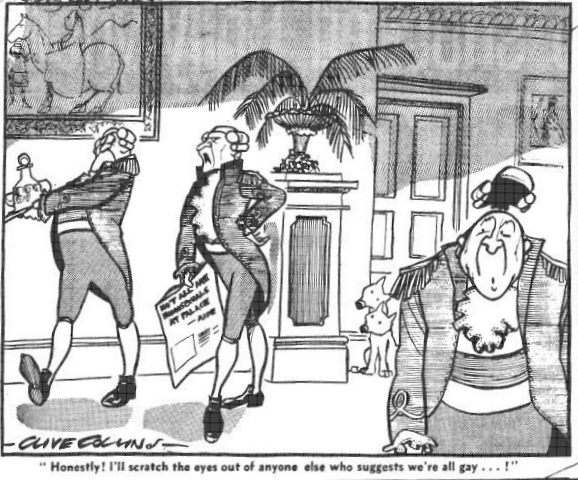
Clive Collins
The Sun, 31 August 1982
A camp bitchy gay. Again the idea of being pervasively infiltrated. Although the “I’ll scratch their eyes out” line has probably been a cliché for at least the last 10 years.

Private Eye
3 December 1982
Analysing the Bridge investigation as a cover-up so as not to further embarrass the Palace. Mr Sweeties Roughtrouser is a name revisited from jokes about Thorpe.

After that Trestrail falls out of the public eye. But there is one last reference. The second volume of Sue Townsend’s Adrian Mole books, “The Growing Pains of Adrian Mole” (1984) has the following topical entry, in which the events of the outside world are brought within Adrian’s self-obsessed petty orbit:

“MONDAY JULY 19TH “The Queen’s personal detective, Commander Trestrail, has had to resign because the papers have found out that he is a homosexual. I think this is dead unfair. It’s not against the law and I bet the Queen doesn’t mind. Barry Kent calls ME a poofter because I like reading and hate sport. So I understand what it is like to be victimized.”

Wednesday, 4 February 2009

220: Attack of the Clones / Send in the Clones / Stop Cloning Around

By the mid ’80-s even the most clueless of cartoonists had started to realise that most homosexuals were not quite the effeminate lipstick-wearing, flouncy sissies they had imagined. Gay cartoonists in gay magazines like “Christopher Street” and “Gay News” had been making jokes before 1980, but those were jokes for the gay audience familiar with the scene. Michael Heath’s “The Gays” strip had noticed fairly early on that there was a distinct new gay identity. Trend-spotter Peter York had an essay about this change in his in 1980 collection of journalism “Style Wars”. The prevalence and flagrancy of the clone, given a few additional touches by way of the leather cop from “The Village People”, would become an easy stereotype for cartoonists for almost the next two decades. Soon it was easy for even the laziest of cartoonists to suggest a homosexual through some combination of: a moustache, an earring, maybe a shaved head or a leather cap, a revealing shirt or string vest, and a bomber jacket. It allows the cartoonist to note that homosexuality is actually about sexuality, but the various elements can be figured to make it all seem a rather silly display (whether you feel that it’s a bit silly already is a whole other matter).

So, just a few, pretty much picked at random:

David Austin in “The Spectator”, 18 February 1984
Another “gay dog”, but now it’s the moustache that confirms homosexuality

“The Gays” by Michael Heath in “Private Eye” 27 July 1984
Is a gay man any more than the sum of his fetishes?

David Austin in “The Spectator”, 8 December 1984
A variant on the “we’re all individuals” line undercut by self-inflicted conformity.

David Austin in “The Spectator” 24 August 1985

Tom Johnston in “The Sun”, 7 March 1987
Pretty much all in one package. The tattoo “Harvey” is there to remind readers of Harvey Proctor, the Tory MP revealed to have had sex with a rent boy earlier in 1987. Kinnock and his two drinking companions are all Labour politicians. But a gay MP is a gay MP.
What would a scary homosexual be? Well just as silly, only larger.

“Are you trying to be funny? Yes we do take heterosexuals actually!”
Charles Griffin in “Daily Express” 6 April 1998
All the traditional effeminate stereotypes about what a gay army would mean. In the parody recruiting poster, all the clone clobber cannot hide inherent nelliness, as the pointing finger becomes a limp wrist. Which never happens in real life, no.

Bill McArthur in “The Glasgow Herald” 9 November 1998

Tom Johnston in “The Sun” 10 November 1998
Cliches about cruising gay men on Clapham Common, inspired by the “lapse of judgement” of Labour MP Ron Davies.

“Matt” in “The Daily Telegraph” 1998
If nothing else, this demonstrates what minimal effort is required to depict a gay cliché.

Dave Gaskill in “The Sun” 24 April 2000
Just your typical gay dad in a scene of congenial domesticity.

Tuesday, 26 August 2008

174: Gay Sports - Football 5

Bernard Cookson in “The Sun” 25 October 1986

Well yes, as far as “The Sun” will ever care, if gay men play football, then of course they’re going to be skinny effeminate twinks in stockings, who when they’re not wearing skirts are wearing just the shortest shorts, with their hands on their hips and carrying handbags, more concerned with gossiping and bitching. Except for the howitzer smoking a pipe on the far right who, I assume, is supposed to be a lesbian.

Monday, 25 February 2008

81: Stanley Franklin


Stanley Franklin in "The Sun" 4 July 1984


Stanley Franklin in "The Sun" 28 September 1984


Stanley Franklin in "The Sun" 25 February 1986


Stanley Franklin in "The Sun" 24 November 1987

Since I think I’ve mentioned him quite a few times, here are some editorial cartoons by Stanley Franklin. They’re not spectacularly hateful, but I am offended by their being so simplistically and thickwittedly stereotypical. It’s that, in a national newspaper, they are still are no better than the sort of graffiti someone might scrawl in junior high. It’s just ridicule, without even much thought, every nasty cliché garbled into an ugly mess. Weird and unabashed limpwristed transvestites with clone moustaches. Fairly badly drawn, they’re just designed to elicit guttural chuckling from the “Sun”-reading slopebrows who know poofs are just wrong. Since “The Sun” is a coarse blokey celebration of conventional appetites, anything outside its world is unblokish and weird. So weird, effeminate poofs are delineated in that same coarse blokish manner. We get the street jibes of the bored construction worker, with not a new hint of wit or thought since they were first learnt as children, drawn with exactly the same lack of skill as that same bored construction might achieve.

Thursday, 10 January 2008

52 - Church outing 1987 (part 2)

When the General Synod convened, the Archbishop of Canterbury Robert Runcie refused to be railroaded by extremists. Instead the Synod was led to take a moderate approach which effectively fell between two stools. The Synod condemned “homosexual genital acts”, but refused to approve any expulsion of homosexual clergy from the Church. So homosexuals got a public beating from the church, but homosexual clergy got to keep their jobs. As “The Sun” so charmingly summed it up the next day, “Pulpit Poofs must stay”.


Stanley Franklin in “The Sun”, 13 November 1987
Stanley Franklin goes for the transvestite motif, and also gets to reuse the “Sun”’s own blatantly offensive phrase. Why think up something new when you can whip up someone else’s thick-witted second-hand vitriol.


Michael Cummings in “The Daily Express”, 13 November 1987
Michael Cumming’s strikes a slightly more moralistic tone. References to Sodom and Gomorrah being slightly more up market. Lot’s Wife is a strangely superfluous and touch, although I suppose it’ll jog the memory of any who can’t quite get what the caption is alluding to. Archbishop Runcie is the driver of the confessional car. This is about the only cartoon to put the event in any sort of context for the Church of England, and what it signifies for Runcie’s leadership. The rest just go for easy comic stereotypes about poofs. Cummings has though chosen to go for the twinkly eyed theatrical stereotype of homosexual.


Mac (Stan McMurtry) in “The Daily Mail”, 13 November 1987
Not an actual homosexual in sight. Just a comic situation. Although it could suggest that homosexuals are so predatory even young bridegrooms have no powers of resistance, or just that she had the wrong sort of taste in men. Anyway, if that’s the way Mac draws his matronly women, no wonder his transvestites look so damn odd.


Bernard Cookson in “The Sun”, 16 November 1987
I honestly don’t know whether to be offended or just contemptuous.


Jak (Raymond Jackson) “Evening Standard”, 16 November 1987
Again, 26 years later JAK reverts to the same blatant show of big-titted heterosexuality to sweep away the gayness as he did in #21
An interesting piece of gossip about JAK. You’ll notice the cartoon conspicuously features “Benson & Hedges” and “C.S.T Wholesale Meat” – which are both real business enterprises. You might think this is just for a touch of realism. But it was revealed that companies who featured in JAK’s cartoons would then buy the originals at surprisingly high rates, so that the companies were effectively rewarding JAK for advertising their brands in his work.